
Martin Guitar Repair and Restoration
Martin guitars span almost two centuries of American guitar making, and no two periods were built quite the same way. Colorado Guitar Repair works on Martins from the 19th century to the present day, with the same aim every time: keep the instrument as original as possible and repair it in the way it was made.
Nearly two centuries of Martin guitars
Christian Frederick Martin trained in the German and Viennese guitar making tradition before emigrating to New York in 1833 and later settling in Nazareth, Pennsylvania, where the company still builds today. The earliest Martins are small, lightly built guitars made for gut strings, and they show their European roots in their outlines and their bracing. Over the 19th century Martin developed the X-braced top that became the pattern for the American flat-top guitar.
The 20th century brought steel strings, larger bodies, the 14-fret neck, and the dreadnought. The details kept changing along the way. Bar frets gave way to modern T-shaped fret wire in the 1930s, top bracing was made heavier during the 1940s, hot hide glue remained the standard adhesive into the 1960s, Brazilian rosewood gave way to Indian rosewood at the end of that decade, and an adjustable truss rod arrived in the 1980s.
Knowing which period a guitar comes from tells us what glue, finish, and construction to expect before any work begins. A repair that suits a recent dreadnought can be the wrong repair for a parlor guitar built a century earlier.
Common problems on Martin guitars
Most of what goes wrong with a Martin is the result of string tension and climate acting on a lightly built wooden box over many decades. These are the repairs these guitars most often need.
Neck angle and neck resets
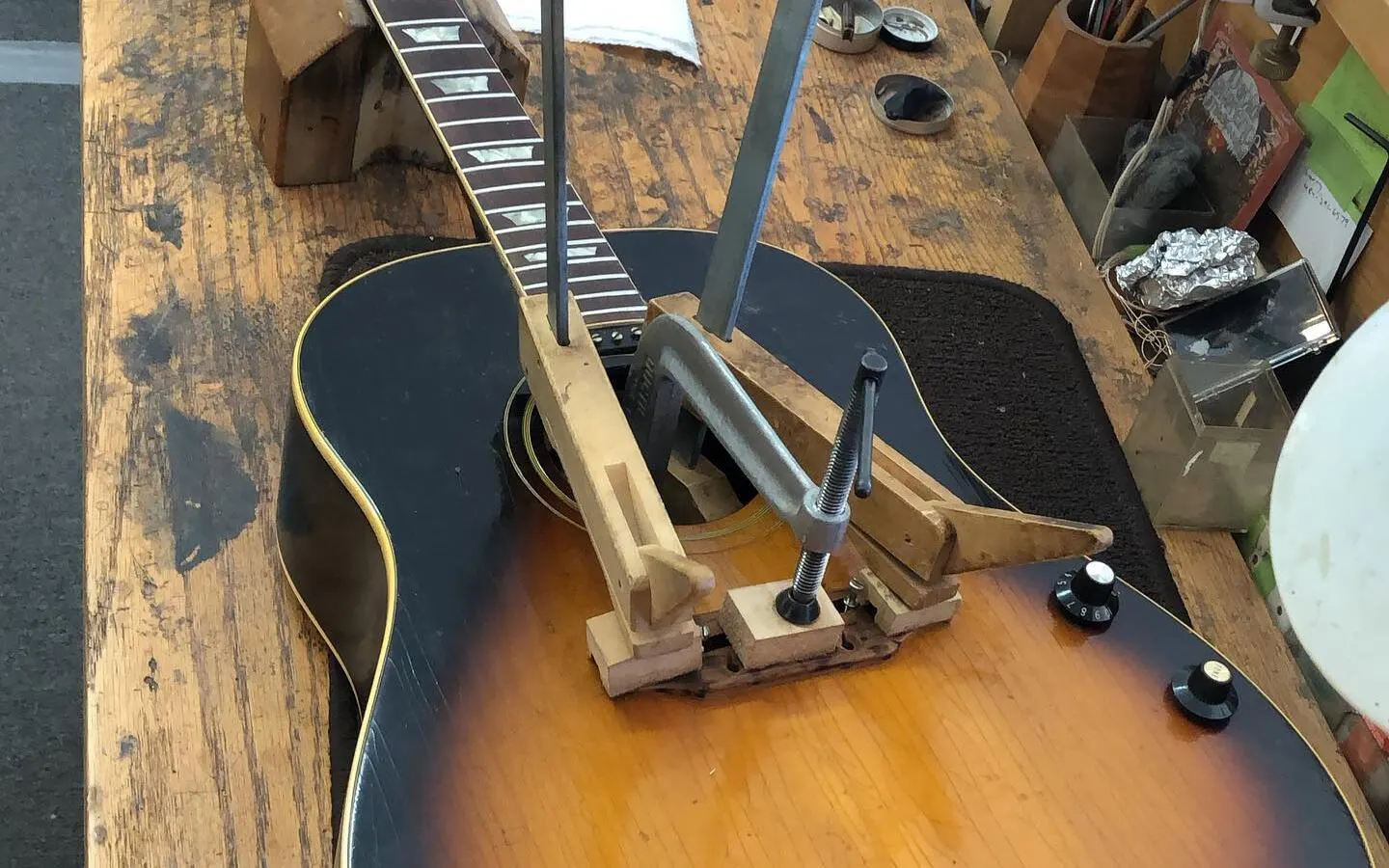
String tension slowly pulls the geometry of a flat-top guitar forward. The action rises, the saddle gets lowered until there is nothing left to take off, and the guitar becomes hard to play. Martin's traditional dovetail neck joint was made to come apart, so the proper repair is a neck reset: the neck is removed, the heel is recut to the correct angle, and the joint is refitted.
Lifting bridges and worn bridge plates
Bridges begin to lift along the back edge, and the small bridge plate inside the guitar is slowly chewed up by string ball ends. Both problems affect tone and stability, and both get worse when they are ignored.
Top belly and loose braces
A little arch behind the bridge is normal on a lightly built guitar. A pronounced belly, or a dip in front of the bridge, usually points to a loose brace or a failing bridge plate.
Cracks
Dry climates such as Colorado's are hard on old spruce, mahogany, and rosewood. Top and side cracks are common. So is the crack along the edge of the pickguard on mid-century guitars, where a shrinking celluloid guard pulls on the top it is glued to.
Fret wear and bar frets
Earlier Martins were built with bar frets, which are fitted and dressed differently from modern fret wire. A refret on one of these guitars should respect that, and the fingerboard should come out of it looking untouched.
Binding and finish
Celluloid binding shrinks with age and pulls loose, most often at the waist. Old finishes check, wear through, and flake. In both cases the goal is to stabilize and conserve what is original.
How we approach a Martin
Much of what makes a vintage Martin special, as a musical instrument and as a piece of history, is tied to its originality. Our work follows the historical restoration discipline that Andrew Mullane trained in during his apprenticeship with Canadian master luthier Edward Victor Dick: respect the methods and the tradition in which the instrument was made, and choose the most ethical and informed repair available.
In practice that means original parts stay on the guitar whenever they can be saved, anything that must be replaced is made to match the original, and finish work is kept to what the instrument needs. We will also say so plainly when a repair you have in mind is not in the guitar's best interest.
Newer Martins are just as welcome. Setups, fretwork, crack repair, pickup installation, and the rest of our repair work apply to a guitar built last year as much as to one built a century ago.
Quotes, estimates, and shipping
We make the official diagnosis with the instrument in hand. Once it has been examined we write a quote for that specific job, and that quote does not change with hourly rates or with how busy the repair queue is.
If you are not local to the shop, email us photos of the instrument and follow up with a phone call so we can talk it through. From there we can give you an approximate estimate of the work to be done before you ship anything.
For a Martin, helpful photos include the full front and back, the bridge from the side, the neck heel, and any cracks, along with the model and serial number stamped on the neck block inside the soundhole.
Call us at (720) 503-2830, email info@coloradoguitarrepair.com, or use the contact form, where you can attach photos.
Related work
- Restorations: our historical restoration services and the full list of instruments and traditions we work on.
- Repairs: setups, fretwork, structural repairs, electronics, and more.
- Harp Guitar Restoration
- Gypsy Jazz Guitar Repair
- Vintage Archtop Guitar Repair
Tell us about your instrument
Send photos and a description, or call (720) 503-2830 to talk it through.