
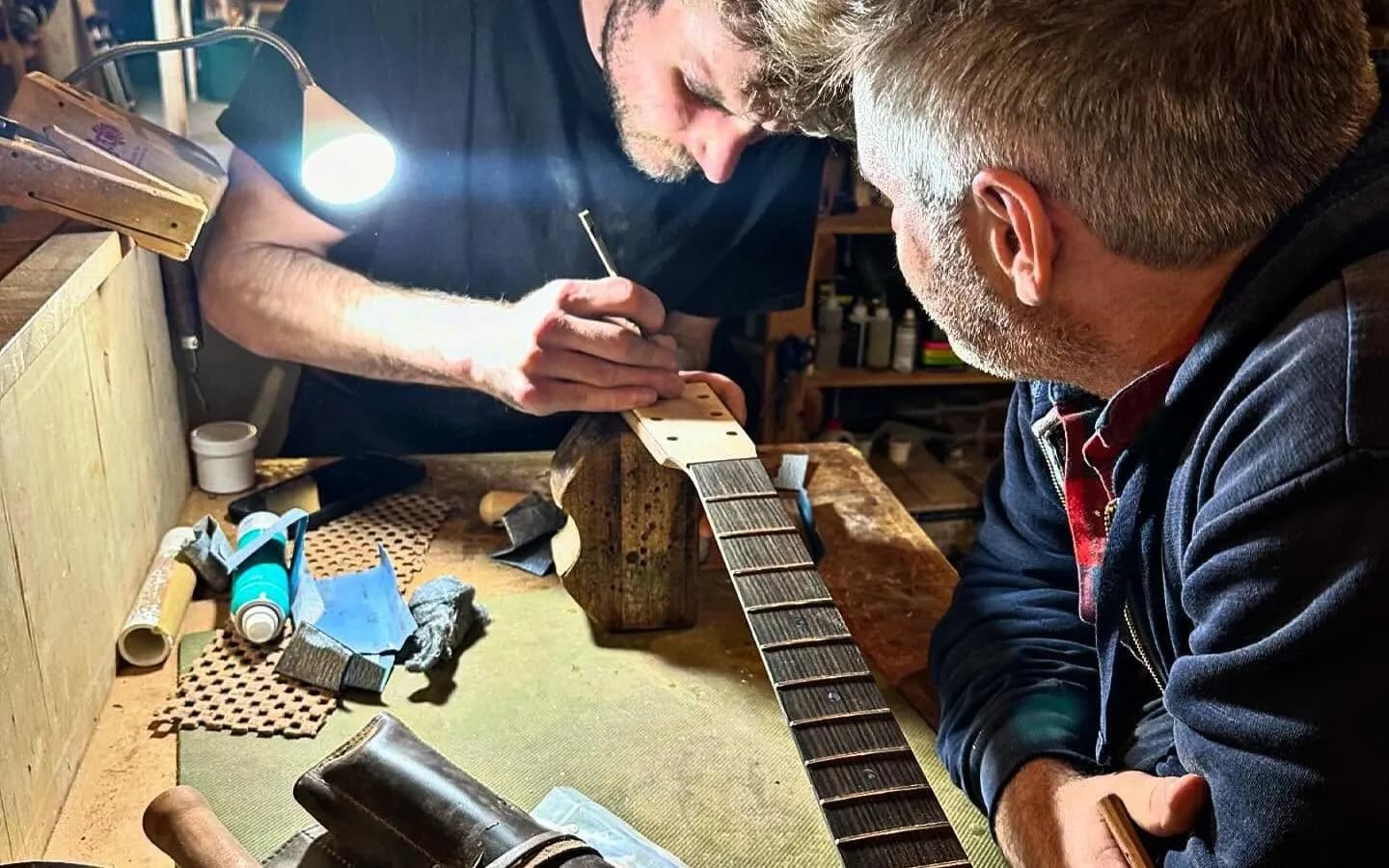
Harp Guitar Restoration
A harp guitar is a guitar with additional unfretted strings, usually sub-basses, that are plucked open like the strings of a harp. Colorado Guitar Repair restores European and American harp guitars from the early 19th century through World War II. They are uncommon instruments, and each one asks for careful study before any work begins.
A short history of the harp guitar
Extra bass strings were being added to guitars in Europe from the early 19th century. Viennese makers built guitars with floating basses running beside the fingerboard, and later in the century the Viennese contraguitar, with a second fretless neck carrying the basses, became the accompaniment instrument of Schrammel music. Italian makers, notably in Genoa, developed large-bodied harp guitars of their own.
In the United States the idea took a different shape in the 1890s and early 1900s. Chris Knutsen patented designs with a hollow arm extending from the body to carry the sub-bass strings. That form was refined in the harp guitars sold by W. J. Dyer and Brother, which were built by the Larson brothers of Chicago. Gibson offered carved-top harp guitars of its own, best known as the Style U, with a bank of sub-basses beside a conventional neck.
By World War II the fashion had largely passed. The instruments that survive are a finite record of a remarkable period in guitar making, which is why they deserve to be repaired with restraint.
Common problems on harp guitars
A harp guitar asks a wooden body to carry far more than a six-string guitar does, often for a century or more. The faults we look for follow from that.
String load on the top and bridge
The combined tension of the guitar strings and the sub-basses is far higher than on a standard guitar. Tops distort, bridges lift or split, and bracing works loose under the load.
Arms, second necks, and bass headstocks
The hollow arm or second neck that carries the sub-basses acts as a long lever. Cracks where it meets the body, open seams, and failed joints at the bass headstock are all common.
Neck angle
The fretted neck is subject to the same forward pull as the neck of any guitar. Correcting it is complicated by the structure built around it.
Tuners and hardware
Bass tuners, tuning pins, tailpieces, and string posts are often missing, mismatched, or worn out, and period-correct replacements are seldom available off the shelf.
Earlier repairs
Many harp guitars have been through previous repairs of varying quality: heavy overspray, unsuitable glues, added bracing. Working out what is original and what is not is part of the job.
Strings and setup
Scale lengths and tunings vary from maker to maker, so a suitable set of strings has to be worked out for each instrument and for the load its structure can safely carry.
How we approach a harp guitar
Harp guitars are one of the movements in instrument making history that Andrew Mullane has focused on since his apprenticeship with Canadian master luthier Edward Victor Dick. The work starts with study: identifying the maker and period, documenting the instrument's condition, and understanding how it was originally built before deciding what to do.
From there the same principles apply that guide all of our historical restoration: the utmost attention to originality, respect for the methods and tradition in which the instrument was made, and the most ethical and informed repair we can offer. Structural work comes first, so the instrument can safely hold tension. Original parts and finish are kept wherever possible.
Some harp guitars will be played daily and some will be conserved as historical objects. We will talk with you about which goal fits your instrument, because the right repair depends on it.
Quotes, estimates, and shipping
We make the official diagnosis with the instrument in hand. Once it has been examined we write a quote for that specific job, and that quote does not change with hourly rates or with how busy the repair queue is.
If you are not local to the shop, email us photos of the instrument and follow up with a phone call so we can talk it through. From there we can give you an approximate estimate of the work to be done before you ship anything.
Harp guitars are large and fragile, so the conversation before shipping matters even more than usual. Photos of the whole instrument, the bass arm or second neck, both headstocks, the bridge, and any label are the most useful starting point.
Call us at (720) 503-2830, email info@coloradoguitarrepair.com, or use the contact form, where you can attach photos.
Related work
- Restorations: our historical restoration services and the full list of instruments and traditions we work on.
- Repairs: setups, fretwork, structural repairs, electronics, and more.
- Martin Guitar Repair and Restoration
- Gypsy Jazz Guitar Repair
- Vintage Archtop Guitar Repair
Tell us about your instrument
Send photos and a description, or call (720) 503-2830 to talk it through.