
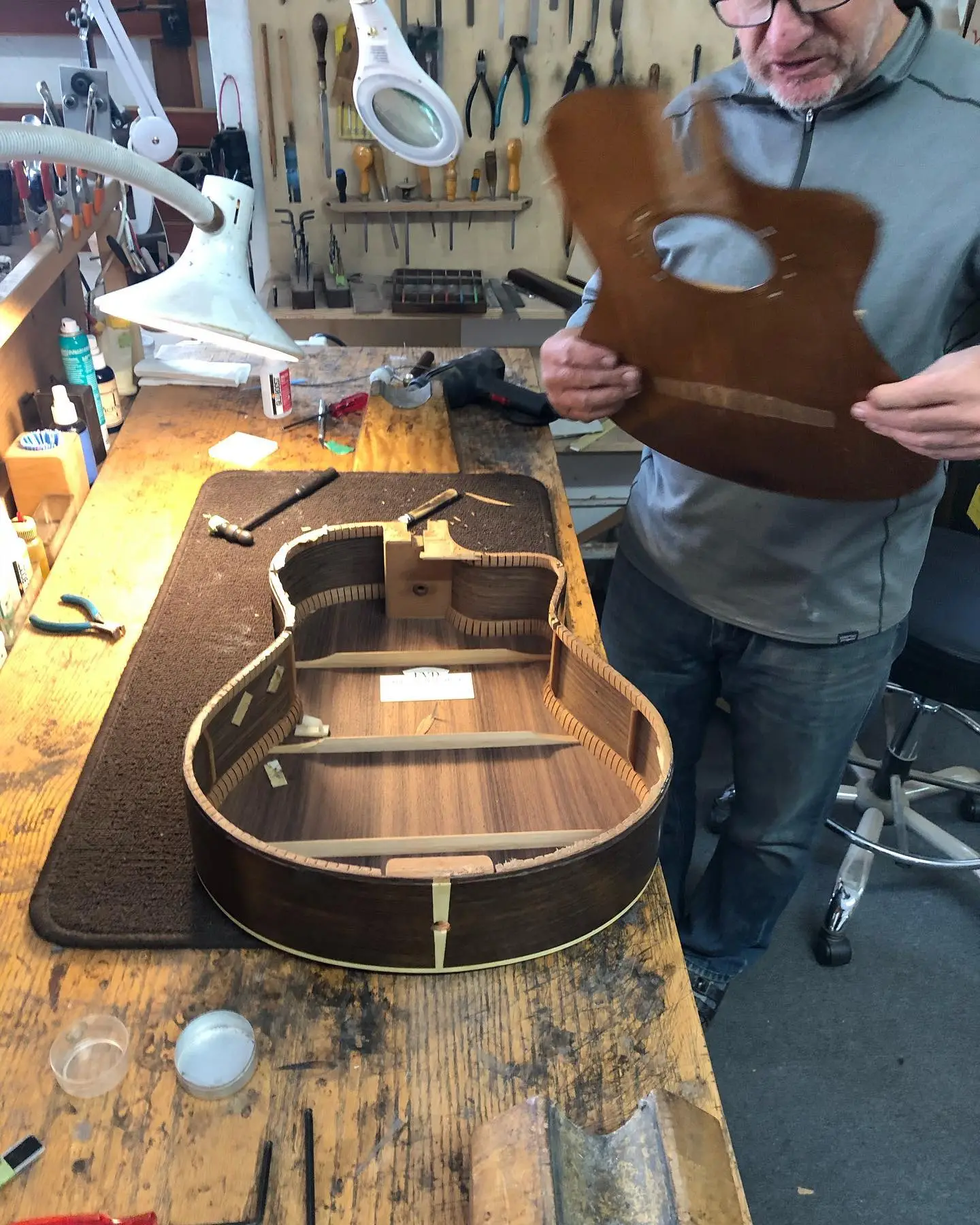
Gypsy Jazz Guitar Repair
The guitar of jazz manouche is unlike any other steel-string guitar: lightly built, ladder braced, fitted with a floating bridge and a tailpiece, and voiced with the dry, cutting sound made famous by Django Reinhardt. Colorado Guitar Repair repairs and restores 20th century Franco-Sicilian guitars and modern instruments built in the same tradition.
From Selmer in Paris to the Franco-Sicilian makers
The design began with Mario Maccaferri, an Italian guitarist and luthier who designed a line of guitars for the Selmer company in Paris in the early 1930s. The first models have a large D-shaped soundhole, a 12-fret neck, and in many cases an internal resonator. After Maccaferri left the company, Selmer moved to the form most players picture today: a small oval soundhole, a 14-fret neck, and a longer scale. Selmer stopped making guitars in the early 1950s.
Alongside Selmer and after it, a community of Italian-born luthiers working in Paris, a number of them from Sicily, built guitars on the same pattern. Makers such as Busato, Di Mauro, and Favino are the best known, and their instruments are sought after in their own right. This is the Franco-Sicilian school that today's gypsy jazz guitars descend from.
The construction is what sets these guitars apart. The top is thin, braced with transverse ladder bars, and given its arch by bending the wood. Backs and sides are typically laminated. The bridge is not pinned to the top. It floats, located by small glued end pieces often called moustaches, and the strings run on to a tailpiece. A zero fret sets the string height at the nut end.
Common problems on gypsy jazz guitars
Light construction is the source of the sound, and it is also the source of most repairs. These are the faults that turn up most often.
Sunken or distorted tops
The arch in the top can flatten or sink under the bridge after decades of string pressure, especially where a brace has come loose. Volume and projection suffer first.
Loose ladder braces
Loose braces cause buzzes and rattles and allow the top to move. They are among the most common faults on older guitars of this type.
Cracks and separating laminates
Thin tops crack, and laminated backs and sides can separate between the plies or open up at the seams.
Bridge fit and action
Because the bridge floats, its feet have to match the top exactly. A poorly fitted or badly chosen replacement bridge costs volume and tone. Action is set at the bridge as well, so height and fit are worked out together.
Fret and zero fret wear
This music is played hard, and frets wear quickly as a result. A worn zero fret brings the open strings down with it and causes buzzing that no bridge adjustment will cure.
Neck relief without an adjustable rod
Many older guitars in this tradition were built without an adjustable truss rod, so relief and neck angle have to be corrected in the wood and the frets.
Tailpieces and tuners
Tailpieces fatigue and break, and tuners wear out. Parts that suit the instrument and its period matter to both the look and the sound.
How we approach a gypsy jazz guitar
Andrew Mullane discovered Django Reinhardt's playing at the age of 12, so these guitars are understood here from the player's side as well as from the bench. Franco-Sicilian guitars are also one of the movements he has focused on since his apprenticeship with Canadian master luthier Edward Victor Dick.
The principles are the ones behind all of our historical restoration: the utmost attention to originality, respect for the methods and tradition in which the guitar was made, and the most ethical and informed repair available. On an original Selmer-era or Franco-Sicilian guitar that means conserving the top, the bracing pattern, the finish, and the original hardware wherever they can be saved.
Modern gypsy jazz guitars get the same attention. Setup on these instruments is its own skill, and a well fitted bridge and properly dressed frets can transform one that sounds thin or plays stiffly.
Quotes, estimates, and shipping
We make the official diagnosis with the instrument in hand. Once it has been examined we write a quote for that specific job, and that quote does not change with hourly rates or with how busy the repair queue is.
If you are not local to the shop, email us photos of the instrument and follow up with a phone call so we can talk it through. From there we can give you an approximate estimate of the work to be done before you ship anything.
For a gypsy jazz guitar, photos of the top taken from a low angle (to show the arch), the bridge and tailpiece, the label, and the soundhole are especially useful.
Call us at (720) 503-2830, email info@coloradoguitarrepair.com, or use the contact form, where you can attach photos.
Related work
- Restorations: our historical restoration services and the full list of instruments and traditions we work on.
- Repairs: setups, fretwork, structural repairs, electronics, and more.
- Martin Guitar Repair and Restoration
- Harp Guitar Restoration
- Vintage Archtop Guitar Repair
Tell us about your instrument
Send photos and a description, or call (720) 503-2830 to talk it through.